Many are looking around and asking, “How the hell did we get here?” The present authoritarian moment did not fall from the sky. It is the latest phase of a conflict that has shaped the United States for more than a century: the struggle between democratic expansion and oligarchic restoration. Again and again, working people and excluded groups have fought to widen democracy, deepen equality, and make public power answerable to the many. Again and again, concentrated wealth has reorganized itself to block, contain, or reverse those gains.
The counterattack has never been purely economic. Great concentrations of wealth do not merely buy power; they generate stories that make hierarchy appear natural, meritocratic, and inevitable. They teach the public to see private power as efficiency, public obligation as waste, and democratic demands as threats to order. American history is therefore not a simple story of democratic progress. It is a recurring struggle over who governs, who benefits from the wealth society creates, and whether ordinary people will act as citizens or merely be managed as spectators.
THE GILDED AGE AND THE FIRST DEMOCRATIC CHALLENGE
A useful place to begin is the Gilded Age. The fortunes of Carnegie, Rockefeller, Morgan, and Vanderbilt were not simply private successes; they helped create a social order in which economic life could be dominated by a small elite while the broader public was encouraged to call that domination “progress.” Trusts and monopolies exercised enormous power over markets, labor, and government itself.
The democratic response emerged quickly. The Knights of Labor and other movements sought a more cooperative and democratic social order. Their significance lies not only in what they achieved but in what they revealed: the central conflict in American life was never merely between parties. It was between concentrated private power and efforts to democratize society itself.
THE OTHER HALF OF POWER: IDEOLOGY
Force and wealth are only part of the story. Unequal systems survive because they develop “moral” and intellectual justifications for themselves. As political economist Thomas Piketty argues, every durable system of inequality is sustained by narratives, institutions, and value systems that make concentration appear legitimate and normal.
This does not require secret meetings or elaborate conspiracies. People who occupy similar positions of wealth and power often come to share similar assumptions about how society should be organized. Over time, those assumptions become common sense. The rich are cast as visionary builders. Markets become the natural, and to an extent, the exclusive measure of value. Democratic demands for redistribution appear irrational, dangerous, or naïve.
As mass media expanded, this ideological function became one of the central instruments of power. A society can be taught to admire the very forces that dominate it. That is one of the deepest challenges facing any democratic movement: we conduct the struggle for democracy inside institutions and cultures shaped by the values of concentrated wealth.
REFORM WITHOUT TRANSFORMATION
The Progressive Era checked some of the worst abuses of concentrated power, but it did not break the deeper logic of oligarchic rule. Antitrust laws and regulatory reforms disciplined excesses while leaving underlying concentrations of wealth largely intact.
Even the solidarities generated by national crises could only partially alter the picture. World War I temporarily challenged what political theorists have called possessive individualism—the belief that society exists primarily as an arena for private advancement rather than collective flourishing. Yet the underlying order remained. Capital still sought what it had always sought: freedom from democratic restraint.
The lesson is simple. Reform can improve lives. It can limit abuses. But unless democratic power is deepened, oligarchic power reorganizes, reloads, and returns.
THE 1920s AND THE WORSHIP OF WEALTH
The 1920s offer one of the clearest examples of oligarchic restoration. Tax cuts, deregulation, and pro-business policies were accompanied by a broader cultural shift. Advertising, mass consumption, and the emerging culture of consumer capitalism increasingly encouraged Americans to measure success not by civic contribution or collective well-being but by acquisition, status, and consumption.
Wealth concentration was treated not as a democratic problem but as proof that the system rewarded merit and vision. Then came the crash of 1929. Once again, crisis exposed the lie. The freer capital became to operate without limits and regulation, the less stable the social order became.
DEPRESSION, NEW DEAL, AND DEMOCRATIC BREAKTHROUGH
The Great Depression weakened the ideological hold of oligarchy enough to make democratic breakthrough possible. But crisis alone did not produce the New Deal. Organization, struggle, labor militancy, and mass pressure from below made it possible.
The New Deal demonstrated that concentrated wealth could be challenged and that public institutions could be used—however imperfectly—to constrain private domination. That legacy helps explain why contemporary authoritarian and right-wing movements remain hostile to New Deal institutions. Programs such as Social Security, labor protections, and public regulation stand as reminders that democratic government can, at least partially, limit private power.
The democratic breakthrough was real, but incomplete. Major exclusions persisted. Black workers, women, domestic workers, and agricultural laborers were never fully incorporated into the settlement that emerged.
POSTWAR GROWTH AND PARTIAL INCLUSION
The postwar period marked the high-water mark of that democratic settlement. Public investment, labor strength, regulation, and broad-based growth allowed many working people to benefit from the wealth they helped create. Yet the deeper conflict between democracy and concentrated wealth was not resolved; it was managed.
That is why the period must be understood as both an achievement and a warning. It showed what democratic commitments could accomplish while leaving intact structures that would later serve as the foundation for a counterattack.
REAGANISM AND NEOLIBERAL RESTORATION
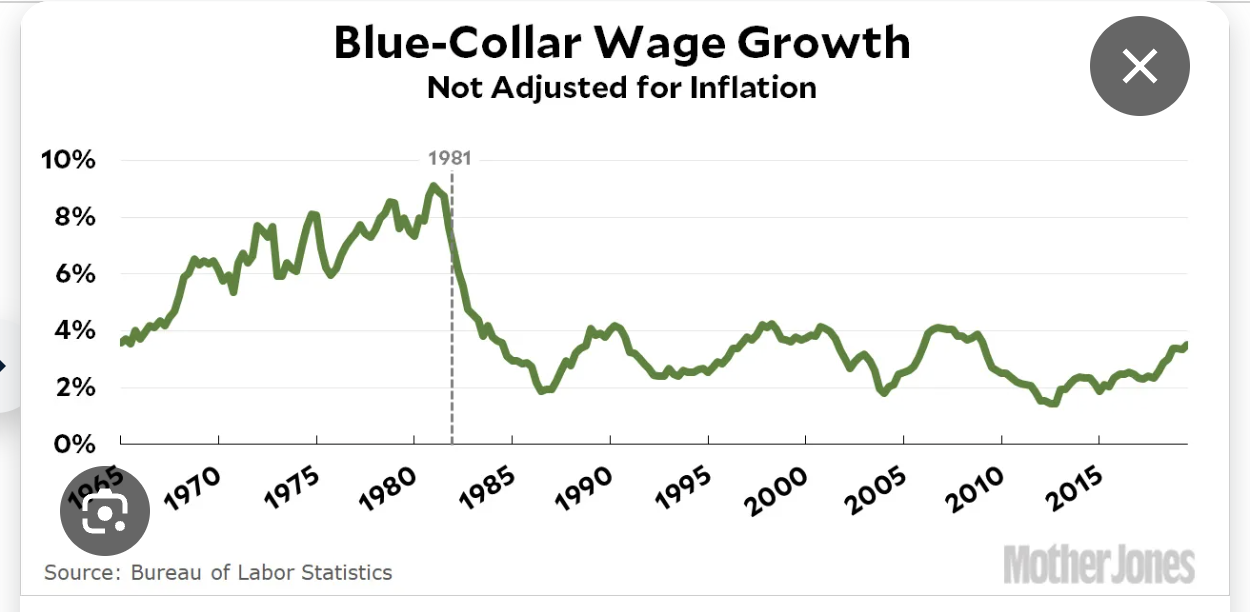
The Reagan era was not merely a conservative turn. It was a restoration project. Make no mistake, the wealthiest and their representatives, are part of an over 2 century effort to put property over people. Deregulation, anti-unionism, privatization, tax cuts for the wealthy, public disinvestment, and market fundamentalism formed part of a larger offensive against the institutions and values associated with the New Deal order.
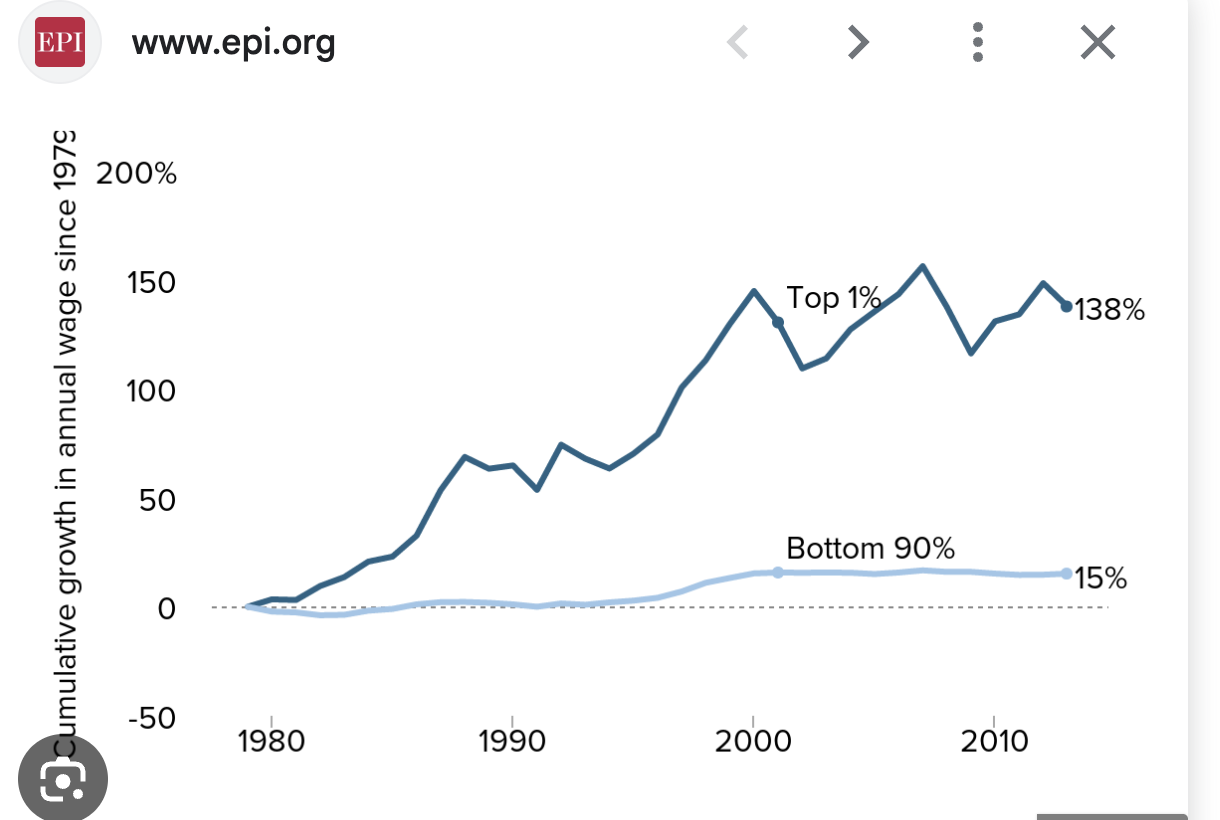
The public was sold a fiction: that education existed primarily to make money, that winning mattered more than solidarity, and that markets were wiser than democratic institutions. Wealth and income increasingly concentrated at the top. Unions were weakened. Public institutions were hollowed out. The rich regained greater freedom to rule while the public was told this was simply modernization. It was not modernization. It was oligarchic restoration.
THE NEOLIBERAL RECORD: 1980–PRESENT
• Productivity rose dramatically.
• Typical worker pay stagnated.
• CEO compensation exploded.
• Union membership collapsed.
• Wealth concentration returned toward Gilded Age levels.
• Corporate profits reached historic highs.
• The gains flowed overwhelmingly to the top.
The issue was never whether material wealth was and should be created. The issue was who captured it.
This ideological transformation had consequences far beyond economics. Decades of market fundamentalism eroded faith in collective solutions, public institutions, and democratic action itself. As insecurity deepened, public anger was increasingly redirected away from concentrated wealth and toward cultural enemies, scapegoats, and manufactured divisions. The groundwork had been laid for a new phase of oligarchic restoration—one that would speak the language of popular revolt while concentrating power even further.
MAGA AND THE LATEST COUNTERATTACK
MAGA is not a break from this history. It is its latest form. It grows from the social wreckage created by neoliberalism and channels the resulting discontent (particularly on the part of those who were the material losers) into authoritarian politics. The same order that weakened labor, hollowed out public institutions, and normalized insecurity now presents itself as a revolt against elites while serving some of the most anti-democratic concentrations of wealth and power.
This is why the present crisis cannot be understood as a cultural aberration. It is the political fire produced by a much longer process in which oligarchic concentration, ideological manipulation, and democratic rollback converged once again.
The following two graphs capture much of these effects:
THE PATTERN AND THE LESSON
Seen across the long arc of American history, the pattern becomes difficult to miss. Wealth concentrates. It justifies itself morally and politically. Crisis follows. Democratic challenge emerges. Reform widens democracy. Oligarchic restoration begins again.
The present authoritarian moment is not an anomaly. It is the latest chapter in a recurring conflict over who governs society and in whose interests. The lesson of the last century is simple: democracy advances when ordinary people organize to expand it. When they do not, concentrated power reorganizes to reclaim what it regards as its natural place at the top of the social order.
What Is to Be Done?
History does not provide a blueprint, but it does offer guidance. Every major democratic advance in American history—from labor rights and voting rights to civil rights and social protections—required organization, coalition-building, and courageous and sustained collective action. None emerged spontaneously, and none were granted voluntarily by concentrated power.
The present crisis is no different. It did not come about in a single election, because of a single leader, or a purely on the back of a wave of anti-democratic extremism. It rises from the very structure of American life, from the massive inequality, from the corrupt and easily corruptible political system. It is structural. Our response must be structural as well. The task before us is democratic reconstruction: rebuilding the organizations, institutions, and broad democratic coalitions capable of exercising meaningful power. It is about recapturing the democratic and communitarian quality of our society, and about expanding on it once again.
The lesson of the last century is not simply that democracy is constantly under threat and must be defended. It is that concentrated wealth and power never stops organizing to protect their privileges and their outsized influence over political, economic, and cultural life. The question for those of us committed to democracy is whether we will be clear-eyed enough to recognize the danger—and whether we will organize with sufficient clarity, urgency, and determination to prevent the next chapter of reactionary decline.
Will we move forward toward a more ethical, equitable, and democratic society, or will we allow oligarchs, authoritarians, and the institutions that serve them to drag us backward once again?
We welcome your thoughts. To respond to something you’ve read or add to the discussion, contact us at defend4demo@cbpr.org